Transparency Provides less information

“Transparency Provides Less Information”
Practical Meaning:
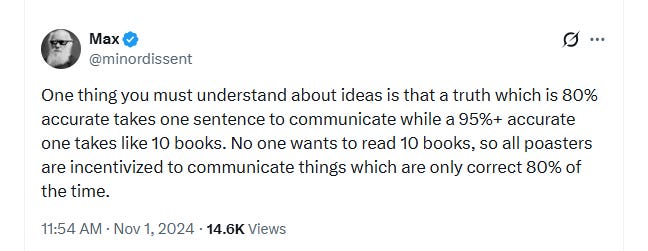
This is about how too much context and/or details can make something *harder* to follow and understand. In this sense, you actually provide *less information* when you try to be “fully transparent” about a situation. In these cases the person or group you’re communicating with gets confused or distracted by all the details being provided. On the flip side, when you offer a clear, focused message, though it may leave out some context, it’s more likely the audience will comprehend the important takeaway you’re trying to communicate.
Extended Explanation:
Transparency of the the details leads to noise around what’s important; that is why it provides less information.
“I would have written a shorter letter, but I did not have the time.”
“Keep it Simple Stupid”
“Explain Like I’m five”
“Less is more”
“TLDR”
Why so much focus on shortening the communication? It’s not because people are lazy, it’s because processing information is hard. You want to make sure your message is heard? Say one thing.
I used to work with a CEO that said “People only remember 20% of what they hear, so I repeat everything 5 times.”
***
It’s tempting to think you’re being helpful when you provide all potentially relevant information on a topic. After all, you probably had to work through a variety of details and scenario planning in order to arrive the decision or general point you’re trying to communicate. The difference is that your activity occurred over a longer period of time; you had time to digest all the information as you worked through it. The context for all the information was clear and connected in an organic way.
But if you try to communicate all that to a person or group in a single short session, it’s *all new* and it’s all coming out at once. More often than not all the context and details will come across more as noise rather than important details that play a critical role because of a certain nuance in the overall situation. This leads to confusion, which leads to the most important thing being missed. You may consider this as transparent, because you’re providing all sort of context and potentially related items, but if you lose the key message you have failed in communicating the most important thing. For example:
If you’re communicating a deadline,, no need to provide detail about all the dependencies and other related workstreams in the project;
If you’re explaining a technical integration, no need to provide all the info about your team is doing under-hood to make it work for the other party;
Such supporting information may seem helpful in theory, but if the other party doesn’t come away with a clear understanding of the deadline, or the work they need to do to build the integration; then the communication was a failure. In this sense, Transparency of the the details leads to noise around what’s important; that is why it provides less information.
This is not to say to hold something back *when asked*. Quite the opposite. But’s much better to get asked a question than provide the information up front. Because if someone asks a question, that means they’re engaged. They’ve heard your message. Therefore, they will be more likely to remember your answer. In may ways the mark of a good communication is getting asked a question. Because it means the person understand what you saying. People *may*remember the answers to questions they ask. They’re don’t remember lots of context when it’s not clear what the key idea is. They’ll just be confused.